Dexcom G7 (10 and 15 Day) vs FreeStyle Libre 3 Plus, updated for 2026: accuracy, warm-up, wear time, alerts, Apple Watch, pump compatibility and cost.
Dexcom G7 and FreeStyle Libre are the two most widely used continuous glucose monitors (CGMs). In the US, Abbott has replaced the FreeStyle Libre 3 sensor with the FreeStyle Libre 3 Plus, and Dexcom now sells the G7 in two versions: the original 10-day sensor and the Dexcom G7 15 Day. In short: Dexcom G7 has more customizable alerts, predictive low warnings, direct-to-Apple-Watch readings and the widest insulin pump support, which is why it is often chosen for type 1 diabetes. FreeStyle Libre 3 Plus lasts 15 days, reads every minute, is approved from age 2, and usually costs less without insurance, which suits many people with type 2 diabetes.
In this article
- What Changed in 2025–2026
- What Is a CGM and How Does It Work?
- Dexcom G7 and G7 15 Day: Key Specs
- FreeStyle Libre 3 Plus: Key Specs
- Dexcom G7 vs FreeStyle Libre 3 Plus: Side-by-Side
- Key Differences for People Who Use Insulin
- Which CGMs Work With a Smartwatch?
- Who Is Dexcom G7 Better For?
- Who Is FreeStyle Libre 3 Plus Better For?
- Cost and Insurance Coverage
- How Glucoly Works with CGM Data
- Wear time: Dexcom G7 lasts 10 days (Dexcom G7 15 Day: 15 days), each with a 12-hour grace period; FreeStyle Libre 3 Plus lasts 15 days.
- Warm-up: 30 minutes for the 10-day Dexcom G7; 60 minutes for both Dexcom G7 15 Day and FreeStyle Libre 3 Plus.
- Accuracy: both report a MARD around 8% in their makers' studies (Dexcom: 8.2% for G7, 8.0% for G7 15 Day). These come from separate studies, not a head-to-head trial.
- Readings: every 5 minutes on Dexcom G7; every minute on FreeStyle Libre 3 Plus. Both stream to a phone over Bluetooth with no scanning or fingerstick calibration.
- Smartwatch: Dexcom G7 can send readings directly to an Apple Watch and has official Garmin apps; Abbott's Libre app has an Apple Watch app (US) that works through the paired iPhone. Neither maker offers an official Wear OS app in the US.
- Cost without insurance: FreeStyle Libre 3 Plus is usually much cheaper per month; Medicare and most insurers cover both for people who use insulin.
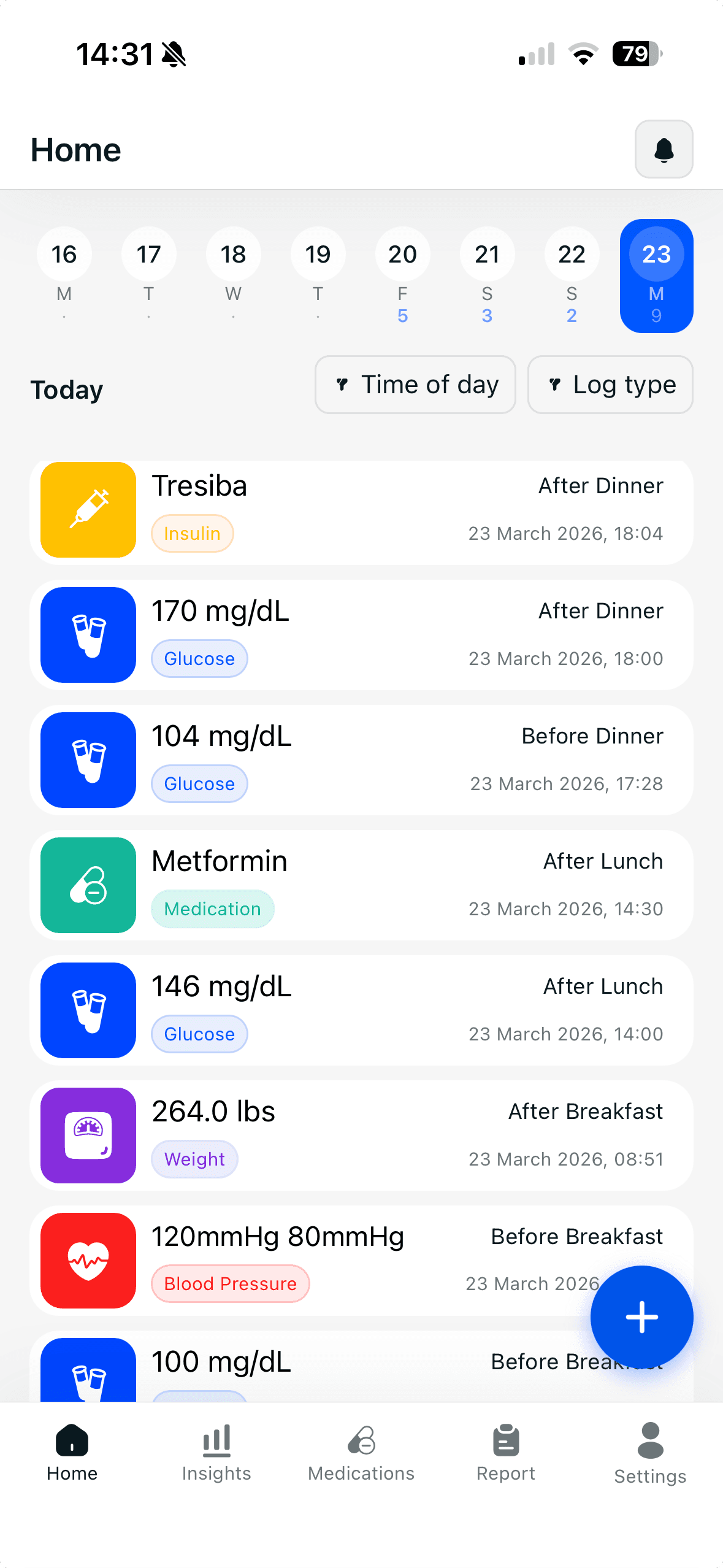
- Glucoly can read Dexcom and FreeStyle Libre data through Apple Health on iPhone, so your readings sit next to the insulin and medications you log.
What Changed in 2025–2026
- FreeStyle Libre 3 became FreeStyle Libre 3 Plus: Abbott discontinued the US Libre 3 and Libre 2 sensors in favor of the Plus versions. The Plus sensor needs a new prescription, but it works with the same apps and reader and has the same Medicare coverage.
- Dexcom G7 15 Day launched: a longer-wear G7 for adults 18 and older. It uses a new algorithm that needs a 60-minute warm-up. Children stay on the standard 10-day G7.
- Apple Watch for Libre: Abbott's Libre app gained an Apple Watch app in late 2025 (US), for compatible Apple Watch models. Readings reach the watch only while the iPhone is in range, and Abbott says not to make treatment decisions from the watch.
- Dexcom safety notices: in March 2025 the FDA sent Dexcom a warning letter about an unvalidated sensor material change, and in 2025 the FDA classed two G7 issues as Class I recalls — receivers whose speaker could fail to sound alerts, and an app defect that could hide a sensor failure. Dexcom replaced affected receivers and fixed the app. Keep your CGM app updated and check the FDA recall database if you use a receiver.
What Is a CGM and How Does It Work?
A continuous glucose monitor is a small wearable device with a thin filament inserted just under the skin, typically on the back of the arm or the abdomen. It measures glucose in the interstitial fluid every few minutes and sends the readings wirelessly to a smartphone app or receiver. Unlike a fingerstick meter, a CGM captures the whole day and night: rises after meals, overnight dips, and patterns that occasional checks would miss.
CGMs display glucose in mg/dL or mmol/L depending on your region and settings, and show trend arrows that tell you whether your sugar is rising, falling or steady. That matters most when deciding on an insulin dose or a snack. Because a CGM reads interstitial fluid rather than blood, it lags a fingerstick by several minutes when glucose is changing fast; if your symptoms don't match the reading, check with a meter.
Dexcom G7 and G7 15 Day: Key Specs
Dexcom G7 builds the transmitter into the sensor, so insertion is a single step. It is cleared for type 1 and type 2 diabetes and for diabetes in pregnancy, and for making insulin decisions without a confirming fingerstick.
- Wear time: 10 days for Dexcom G7, 15 days for Dexcom G7 15 Day, both with a 12-hour grace period to change the sensor. Not every sensor reaches the end of its wear period, so keep a spare.
- Warm-up: 30 minutes (G7) or 60 minutes (G7 15 Day).
- Accuracy: MARD of 8.2% for G7 and 8.0% for G7 15 Day in Dexcom's data. Lower MARD means readings sit closer to lab values.
- Ages: G7 from age 2; G7 15 Day adults 18 and older.
- Readings: every 5 minutes, sent automatically to the Dexcom G7 app, a Dexcom receiver, or both.
- Alerts: customizable high and low alerts, an urgent low alert at 55 mg/dL (3.1 mmol/L), an urgent low soon alert that warns up to 20 minutes before a predicted low, and alert schedules that can differ by time of day.
- Apple Watch: Direct to Watch shows readings on an Apple Watch (Series 6 or later, watchOS 10 or later) even when your iPhone is not nearby. It works with both G7 and G7 15 Day; you still need the iPhone to pair each new sensor.
- Garmin: the Dexcom Connect IQ widget and data field, developed by Garmin, show G7 readings on many Garmin watches while the phone is in range.
- Sharing: Dexcom Follow lets up to 10 people see your readings in real time — useful for parents of children with type 1 diabetes.
- Reports: Dexcom Clarity for retrospective reports you can share with your clinic.
FreeStyle Libre 3 Plus: Key Specs
FreeStyle Libre 3 Plus is Abbott's current US sensor in the Libre 3 line, roughly the size of two stacked coins. Like the Libre 3 before it, it streams readings automatically over Bluetooth, so there is no scanning.
- Wear time: 15 days per sensor.
- Warm-up: 60 minutes.
- Accuracy: Abbott reports a MARD around 8%; published figures range from about 8% to 9% depending on the study and age group.
- Ages: approved from age 2.
- Readings: every minute, streamed to the FreeStyle Libre 3 or Libre app, or to a Libre 3 reader.
- Alerts: optional real-time high and low alerts, with fewer customization options than Dexcom.
- Apple Watch: the Libre app's Apple Watch app shows your current reading and trend graph through the paired iPhone (US only for now).
- Sharing and reports: LibreLinkUp for family sharing and LibreView for clinic reports.
- Prescription: a Libre 3 prescription does not carry over — you need a new one written for Libre 3 Plus.
Dexcom G7 vs FreeStyle Libre 3 Plus: Side-by-Side
- Accuracy: very similar — both around 8% MARD in their own studies, and both cleared for insulin dosing decisions.
- Warm-up: the 10-day Dexcom G7 is fastest at 30 minutes; Dexcom G7 15 Day and Libre 3 Plus both take 60 minutes.
- Wear time: 15 days for Libre 3 Plus and Dexcom G7 15 Day; 10 days for the standard G7. Longer wear means two sensor changes a month instead of three.
- Reading frequency: every minute on Libre 3 Plus, every 5 minutes on Dexcom G7. Both are frequent enough for day-to-day decisions.
- Alerts: Dexcom offers more control — predictive urgent-low warnings, per-time-of-day schedules and custom thresholds. Libre 3 Plus alerts are simpler.
- Smartwatch: Dexcom G7 connects directly to Apple Watch and has official Garmin apps; Libre uses the iPhone app's Apple Watch companion (US). For Wear OS, neither has an official app in the US.
- Pump compatibility: Dexcom G7 works with Omnipod 5, Tandem t:slim X2, Tandem Mobi and Beta Bionics iLet. Abbott lists Libre 3 Plus as compatible with Omnipod 5, Tandem t:slim X2, iLet and twiist, though rollout varies by pump and country. G7 15 Day support is still being added pump by pump.
- Cost without insurance: Libre 3 Plus usually costs much less; see the cost section below.
- Children: Libre 3 Plus and the 10-day Dexcom G7 are approved from age 2; Dexcom G7 15 Day is adults only.
Key Differences for People Who Use Insulin
If you take insulin, by injection or with a pump, the differences that matter most are alerts, pump support and how each sensor behaves around a sensor change. Both systems are cleared for making insulin decisions without a confirming fingerstick.
- Low alerts: Dexcom G7 has an urgent low alert at 55 mg/dL (3.1 mmol/L) plus an urgent low soon alert up to 20 minutes before a predicted low, with schedules that can differ by time of day. FreeStyle Libre 3 Plus has optional high and low alerts with fewer settings. People with hypoglycemia unawareness or frequent overnight lows often prefer the predictive alert.
- Automated insulin delivery: both work with several pumps (see the list above), but support is per sensor, not per brand. Check that your pump runs with the exact sensor you are prescribed; G7 15 Day support is still being added pump by pump.
- Sensor changes: a new sensor gives no readings until its warm-up ends, 30 minutes for the 10-day G7 and 60 minutes for G7 15 Day and Libre 3 Plus. Plan changes away from meals and bedtime, and keep a meter for that window.
- Sharing with family: Dexcom Follow shares readings with up to 10 people; Abbott uses LibreLinkUp. Useful for parents and for anyone who lives alone and has overnight lows.
- Whatever the CGM says, check with a fingerstick meter when your symptoms don't match the reading or glucose is changing fast.
Which CGMs Work With a Smartwatch?
- Dexcom G7 + Apple Watch: official Direct to Watch on Series 6 or later with watchOS 10 or later; the watch keeps receiving readings when your iPhone is out of range.
- Dexcom G7 + Garmin: official Dexcom Connect IQ widget and data field, with the phone in range.
- FreeStyle Libre 3 Plus + Apple Watch: official through Abbott's Libre app for Watch (US), with the iPhone in range.
- Wear OS (Samsung Galaxy Watch, Google Pixel Watch) and Fitbit: no official app from either maker in the US; third-party apps exist but are not endorsed.
For every CGM and smartwatch combination, with the watch models and app versions the makers publish, see our guide to the best smartwatches for diabetes.
Who Is Dexcom G7 Better For?
- Type 1 diabetes and automated insulin delivery: the widest pump compatibility and the most customizable alerts.
- People with hypoglycemia unawareness or frequent overnight lows: the urgent low soon alert warns up to 20 minutes before a predicted low.
- Apple Watch users who want readings without carrying their phone: Direct to Watch.
- Parents and caregivers: Dexcom Follow shares readings with up to 10 people.
- Adults who want 15-day wear but prefer Dexcom's alerts: Dexcom G7 15 Day.
Who Is FreeStyle Libre 3 Plus Better For?
- Type 2 diabetes, including people on oral medication or GLP-1s who want to see how meals and activity affect them without paying for features they won't use.
- Self-pay users: usually the lower monthly cost.
- People who want fewer sensor changes: 15 days of wear.
- Children from age 2 who want 15-day wear, which Dexcom only offers to adults.
- People outside the US: FreeStyle Libre is widely available across Europe and Asia. Check which Libre and Dexcom sensors are sold and reimbursed in your country, as the line-up differs from the US.
Cost and Insurance Coverage
Prices change often and vary by pharmacy, country and discount program, so treat these as rough US figures from late 2026 and check current prices before you decide.
- FreeStyle Libre 3 Plus without insurance: roughly $70–160 a month for two sensors, depending on the pharmacy and discount card used.
- Dexcom G7 without insurance: roughly $250–400 a month at retail for a 30-day supply, lower with pharmacy discount cards or Dexcom's savings programs.
- Medicare Part B: covers both with a prescription for people with diabetes who use insulin or have a history of problematic low blood sugar. Libre 3 Plus has the same Medicare coverage as Libre 3 had.
- Medicaid: coverage varies by state; most programs cover CGMs for people who use insulin.
- Private insurance: most plans cover CGMs for insulin users; coverage for type 2 diabetes without insulin varies and often needs prior authorization.
- Manufacturer programs: both Dexcom and Abbott offer savings cards for eligible patients. See dexcom.com and freestyle.abbott for current offers.
- Not on insulin? Both companies also sell over-the-counter biosensors for people who don't use insulin (Dexcom Stelo; Abbott Lingo and Libre Rio). They have no urgent alerts and aren't meant for insulin dosing.
How Glucoly Works with CGM Data
Glucoly is a blood sugar tracking app for iPhone and Android. It is not a CGM and does not replace one. Because the Dexcom and FreeStyle Libre apps can write glucose readings to Apple Health, Glucoly can import that data automatically on iPhone, giving you a unified view of your glucose history alongside other health metrics you log manually.
- Apple Health sync: Glucoly reads CGM data from Apple Health (Dexcom and FreeStyle Libre), so your readings appear without manual entry. Data that passes through Apple Health can arrive with a delay.
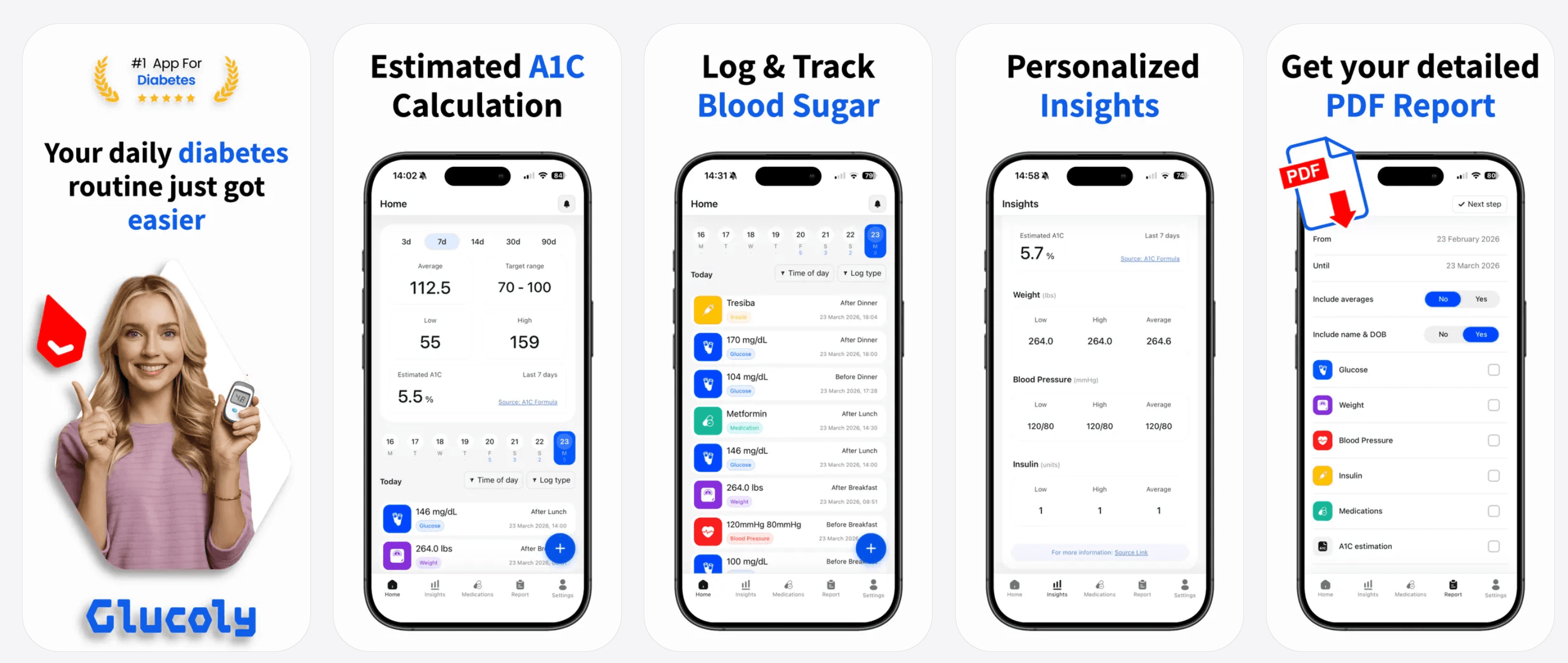
- Trend analysis: Glucoly displays trend windows from 3 to 90 days across all logged metrics, helping you see how glucose patterns shift over time.
- Doctor-ready export (Glucoly Premium): generate a PDF report of your glucose log to share with your care team, whether your data comes from a CGM or manual fingerstick readings.
- Multi-metric tracking: log blood pressure, weight, insulin doses, and medications alongside your CGM glucose data for a complete picture of your health.
This article is for general educational purposes and does not constitute medical advice. Product details, compatibility and prices change; confirm them with the manufacturer, your pharmacy or your diabetes care team. The choice of CGM should be made with your care team based on your clinical needs, insurance and treatment goals, and you should always follow your doctor's guidance for insulin dosing and glucose targets.
Sources
- Dexcom. Why does Dexcom G7 15 Day require a 60-minute warm up? dexcom.com
- Dexcom. Dexcom G7 vs. Dexcom G7 15 Day vs FreeStyle Libre 3 and Libre 3 Plus. dexcom.com
- Dexcom. Provider FAQs: Dexcom G7 15 Day pump compatibility. provider.dexcom.com
- Abbott. Transition to FreeStyle Libre 3 Plus or 2 Plus. freestyle.abbott
- Abbott. Compatible insulin pumps. freestyle.abbott
- Abbott. Apple Watch models compatible with the Libre Watch app. freestyle.abbott
- Dexcom. What are the device and operating system requirements for Direct to Watch? dexcom.com
- Dexcom. Dexcom G7 compatible devices. dexcom.com/en-us/compatibility/g7
- Garmin. Dexcom Connect IQ apps for Garmin smartwatches and Edge cycling computers (press release). garmin.com/newsroom
- Abbott. FreeStyle Libre 3 Plus (provider information). provider.freestyle.abbott
- American Diabetes Association. Consumer Guide: Dexcom G7 and G7 15 Day; FreeStyle Libre 3 and 3 Plus. consumerguide.diabetes.org
- MedTech Dive. Dexcom's FDA warning letter reveals unauthorized changes to sensors (March 2025). medtechdive.com
- Fierce Biotech. Dexcom replaces hand-held CGM receivers after missed audio alerts (2025). fiercebiotech.com
- SingleCare. How much does Dexcom G7 cost without insurance? singlecare.com
- American Diabetes Association. Standards of Care in Diabetes — Diabetes Technology. diabetesjournals.org
Track your blood sugar and spot patterns with Glucoly - free to download on iOS and Android with unlimited logging, plus Glucoly Premium for estimated A1C and detailed reports.
Download GlucolyShare this article
Related Posts
What Is LADA (Type 1.5 Diabetes)? Symptoms and How It Differs from Type 1 and Type 2
LADA (type 1.5 diabetes) is autoimmune diabetes that develops slowly in adults, often misdiagnosed as type 2.…
Read more →EducationDiabetic Retinopathy: How Diabetes Affects Your Eyes (and How to Protect Them)
Diabetic retinopathy is a leading cause of blindness in working-age adults — largely preventable. Learn the st…
Read more →EducationWhat Is Diabetic Ketoacidosis (DKA)? Warning Signs You Must Know
DKA is a life-threatening diabetes emergency. Know the warning signs — fruity breath, vomiting, confusion — an…
Read more →