Find out how many times a day to check blood sugar with Type 2 diabetes - based on your treatment type, ADA guidance, and when to test more often.
For Type 2 diabetes, the right testing frequency depends primarily on your treatment plan. People managing with diet and oral medications typically need 1–2 checks per day, with a fasting morning reading being the most informative. Those on basal insulin add a bedtime check. People on multiple daily injections follow the same schedule as Type 1 - before each meal and at bedtime. Your healthcare provider should set a schedule tailored to your medications and personal goals.
In this article
- ADA Guidance on Blood Sugar Monitoring Frequency
- For Diet and Oral Medications Only
- For Insulin Users - Basal Only
- For Multiple Daily Injections
- When to Check More Often
- Best Times to Check and What Each Reading Tells You
- CGM as an Alternative to Finger-Stick Testing
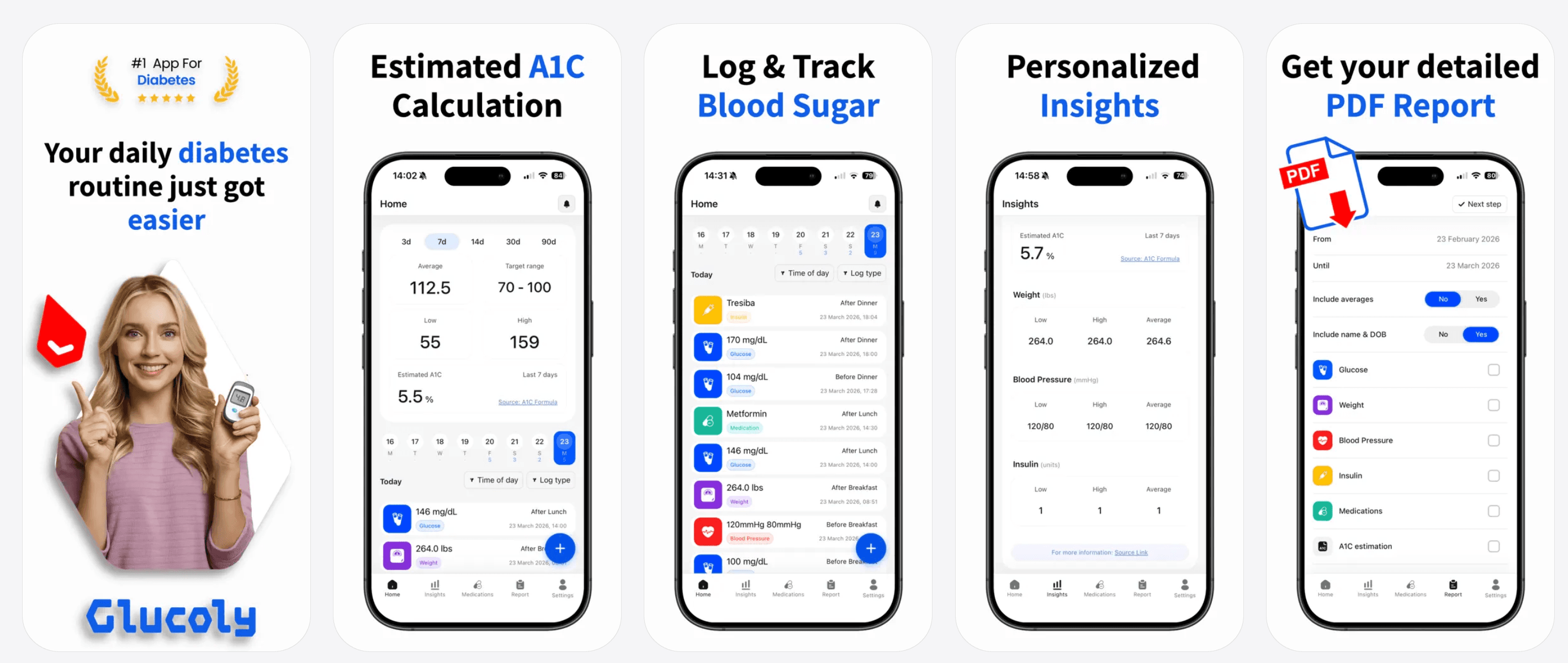
- How Glucoly's Smart Reminders Support Your Testing Schedule
- Do Type 2 diabetics need to check blood sugar daily?
- What is the best time to check blood sugar in the morning?
- Is it necessary to check blood sugar after every meal?
- At a Glance: Diet/oral medications - 1–2 checks per day minimum; fasting reading is the most valuable.
- Basal insulin: fasting + bedtime at minimum; bedtime check prevents dangerous nocturnal hypoglycemia.
- Multiple daily injections (MDI): before each meal + bedtime - at least 4 checks per day.
- Always check more during illness, new medications, unexplained symptoms, or around exercise.
- Best times: fasting (morning), pre-meal, 1–2 hours post-meal, bedtime.
- CGM integration via Apple Health lets Glucoly display continuous readings without manual entry.
ADA Guidance on Blood Sugar Monitoring Frequency
The American Diabetes Association does not prescribe a single universal testing schedule for Type 2 diabetes - because the right number of daily checks depends on your treatment type, glucose control, and personal goals. The key principle is that testing should be frequent enough to give you the information you need to make safe daily decisions.
For Diet and Oral Medications Only
If you manage Type 2 diabetes with lifestyle changes alone - or with oral medications such as metformin, sulfonylureas, or GLP-1 receptor agonists - your risk of hypoglycemia is generally low (unless you take a sulfonylurea). Testing 1–2 times per day is often sufficient to monitor trends.
- Fasting glucose (immediately after waking, before eating or drinking anything): the most important single reading in Type 2 management - it reflects overnight glucose control.
- Pre-meal reading: gives you a baseline before eating and helps identify pre-meal highs.
- 2-hour post-meal reading: shows how a specific meal affected your blood sugar; glucose typically peaks 1–2 hours after the first bite.
- If you are on a sulfonylurea or meglitinide - both can cause hypoglycemia - your provider may recommend checking more frequently.
For Insulin Users - Basal Only
If you inject a single dose of long-acting (basal) insulin each day - such as glargine (Lantus, Toujeo), detemir (Levemir), or degludec (Tresiba) - checking at least twice daily is important.
- Fasting reading: your primary signal for whether your basal dose is appropriate. Consistently high fasting readings may indicate the basal dose needs adjustment - discuss with your provider.
- Bedtime reading: critical. If your blood sugar is below 90–100 mg/dL (5.0–5.6 mmol/L) at bedtime, there is meaningful risk of nocturnal hypoglycemia - a dangerous low during sleep when you cannot feel symptoms.
For Multiple Daily Injections
If you take both basal and bolus insulin (multiple daily injections, or MDI), your monitoring schedule resembles Type 1 diabetes management - a minimum of 4 checks per day.
- Before breakfast (fasting)
- Before lunch
- Before dinner
- At bedtime
- More checks are needed when blood sugar is unstable, when adjusting doses, or when ill.
When to Check More Often
Certain situations always call for increased monitoring frequency, regardless of your usual schedule.
- During illness: infection and inflammation raise blood sugar significantly - check every 2–4 hours.
- With new medications: starting or changing a diabetes medication often requires tighter monitoring for the first 1–2 weeks.
- Unexplained symptoms: dizziness, sweating, headache, extreme fatigue - check immediately; do not assume.
- Before and after exercise: aerobic exercise typically lowers blood sugar; check before starting and 1 hour after finishing.
- After significant dietary changes: a new meal plan warrants extra monitoring until the impact on your readings is understood.
- During pregnancy: if pregnant with Type 2 diabetes, testing frequency increases substantially - follow your OB's schedule.
Best Times to Check and What Each Reading Tells You
Timing your checks strategically gives each reading maximum diagnostic value.
- Fasting (first thing in the morning, before eating): reflects overnight glucose production and your basal insulin or oral medication effectiveness.
- Pre-meal: your starting point before food - shows what level each meal begins from.
- 1–2 hours post-meal: shows how high a specific meal pushed your blood sugar. According to the ADA, the 2-hour post-meal target for most people with diabetes is below 180 mg/dL (10.0 mmol/L).
- Bedtime: safety check before sleeping - especially critical for insulin users.
- 3 AM (occasional): if you frequently wake with high blood sugar, a 3 AM check helps distinguish between the dawn phenomenon and nocturnal hypoglycemia followed by rebound.
CGM as an Alternative to Finger-Stick Testing
Continuous glucose monitors (CGMs) such as the Dexcom G6/G7 and Freestyle Libre 2/3 measure glucose every 5–15 minutes automatically - replacing the need for multiple daily finger sticks. Rather than snapshots at specific moments, you see the complete glucose curve through the day and night, including trends and rate of change.
Glucoly syncs automatically with both Dexcom and Libre via Apple Health. Once you enable Apple Health sync in Glucoly settings, all CGM readings flow directly into the app - no manual entry required.
How Glucoly's Smart Reminders Support Your Testing Schedule
Consistency is the biggest challenge in blood sugar monitoring. Even people with the best intentions miss readings when life gets busy. Glucoly's smart reminders let you set up custom alerts for glucose checks, insulin doses, and medications - fasting reminders at 6 AM, pre-lunch reminders at noon, bedtime check reminders at 10 PM. The app prompts you so you don't have to rely on memory.
This article is for general education and is not medical advice. Consult your healthcare provider before making changes to your treatment plan. Blood sugar monitoring frequency should be determined in consultation with your diabetes care team.
Frequently Asked Questions
Do Type 2 diabetics need to check blood sugar daily?
- Most people with Type 2 diabetes on medication - especially insulin or sulfonylureas - benefit from at least one daily glucose check.
- For those managing with diet and exercise alone, daily testing may be less critical - but still provides useful feedback on how food, stress, and activity affect blood sugar.
- The American Diabetes Association recommends discussing testing frequency with your provider based on your specific treatment plan.
- Consistent daily data, even just a morning fasting reading, enables pattern recognition that occasional testing cannot.
What is the best time to check blood sugar in the morning?
- The best time to check fasting blood sugar is immediately after waking - before eating, drinking (except water), or taking morning medications.
- According to the ADA, the fasting blood sugar target for most people with diabetes is 80–130 mg/dL (4.4–7.2 mmol/L).
- Taking medications before checking can affect the reading - always check before morning meds unless your provider advises otherwise.
- Log your fasting reading at the same time each morning in Glucoly to build a consistent, comparable baseline trend.
Is it necessary to check blood sugar after every meal?
- For most people with Type 2 diabetes on oral medications, checking after every meal is not required - but checking after specific meals you are uncertain about can be informative.
- The 1–2 hour post-meal check is most useful when introducing new foods, starting a new meal plan, or troubleshooting unexplained post-meal highs.
- If you are on mealtime insulin, checking before and after each meal is standard practice.
- A CGM, synced to Glucoly via Apple Health, effectively checks after every meal automatically - without any additional effort.
Sources
- American Diabetes Association. Standards of Medical Care in Diabetes 2024. diabetes.org
- Centers for Disease Control and Prevention. Managing Diabetes. cdc.gov/diabetes/managing
Set up Glucoly's smart reminders for your fasting, pre-meal, and bedtime glucose checks - and let Apple Health bring in your CGM data automatically. Free on the App Store and Google Play.
Download GlucolyShare this article
Related Posts
5 Easy Ways to Track Your Blood Sugar Every Day
Managing blood sugar levels doesn't have to feel overwhelming. Here are five practical, evidence-backed ways t…
Read more →Diabetes4 Free Diabetes Calculators to Bookmark in 2026
Blood sugar converter, A1C calculator, insulin correction factor, and carb counter — free online tools for dia…
Read more →DiabetesBest Diabetes Tracking Apps of 2026 (Reviewed & Ranked)
The top diabetes tracking apps of 2026 compared — Glucoly, mySugr, Dario, Glucose Buddy, and One Drop ranked b…
Read more →