There are five main types of insulin - rapid-acting, short-acting, intermediate, long-acting, and ultra-long-acting. Learn how each works and when it's used.
There are five main types of insulin, grouped by how quickly they start working and how long they last: rapid-acting (onset 10–15 minutes), short-acting or regular (onset 30–60 minutes), intermediate-acting (onset 1–2 hours), long-acting or basal (onset 1–2 hours, lasts ~24 hours), and ultra-long-acting (lasts 42 hours or more). People with Type 1 diabetes typically need both a basal and a bolus insulin. People with Type 2 diabetes on insulin may use one or several types depending on their regimen.
In this article
- Why Understanding Insulin Types Matters
- Rapid-Acting Insulin: The Meal-Time Workhorse
- Short-Acting (Regular) Insulin: The Older Bolus Option
- Intermediate-Acting Insulin (NPH): Twice-Daily Coverage
- Long-Acting (Basal) Insulin: The Foundation of T1D Therapy
- Ultra-Long-Acting Insulin: Flatter and More Stable
- Premixed Insulins: Convenient but Less Flexible
- Basal-Bolus Therapy: Why T1D Needs Both
- How Logging Insulin Doses in Glucoly Reveals What's Working
- What is the difference between basal and bolus insulin?
- Do people with Type 2 diabetes need insulin?
- How should I store insulin?
- At a Glance: Rapid-acting insulin (Humalog, Novolog, Fiasp) is taken just before or after meals - onset in 10–15 minutes.
- Short-acting / Regular insulin (Humulin R) acts in 30–60 minutes - used less commonly now but still prescribed.
- Intermediate-acting (NPH / Humulin N) peaks in 4–12 hours and is used in some twice-daily Type 2 regimens.
- Long-acting basal insulin (Lantus, Basaglar, Levemir) provides ~24-hour coverage with no pronounced peak.
- Ultra-long-acting insulin (Toujeo, Tresiba) lasts 42 hours or more for a flatter, more stable baseline.
- Premixed insulins combine a fixed ratio of basal and bolus - convenient but less flexible.
- Most people with T1D use basal-bolus therapy: one long-acting injection plus rapid-acting doses at every meal.
Why Understanding Insulin Types Matters
Not all insulin is interchangeable. Each type has a distinct onset (when it starts working), peak (when it works hardest), and duration (how long it lasts). Using the wrong type at the wrong time - or misunderstanding when your insulin peaks - can result in blood sugar that stays too high after meals or drops dangerously low hours later.
According to the American Diabetes Association, matching the right insulin type to the right situation is one of the core skills of insulin management. A long-acting insulin won't cover a meal spike, and a rapid-acting insulin won't provide 24-hour background coverage. Understanding these differences helps you and your care team build a regimen that keeps glucose in range around the clock.
- Onset: how many minutes or hours before the insulin begins lowering blood sugar.
- Peak: the window when the insulin is working most powerfully - when hypoglycemia risk is highest.
- Duration: how long the insulin remains active in the body.
- Timing mismatches are a common cause of unexpected highs and lows - knowing your insulin's profile lets you plan around it.
Rapid-Acting Insulin: The Meal-Time Workhorse
Rapid-acting analogs are the most commonly prescribed bolus insulin today. They are designed to mimic the fast burst of insulin a healthy pancreas releases in response to food. Because they work within minutes, you can inject just before sitting down to eat - or even shortly after starting a meal if you're unsure how much you'll eat.
Common brands include insulin lispro (Humalog), insulin aspart (Novolog / NovoRapid), and insulin aspart ultra-fast (Fiasp). Fiasp is formulated with niacinamide to accelerate absorption, making it the fastest currently available in most markets.
- Onset: 10–15 minutes (Fiasp may begin acting in as little as 5 minutes).
- Peak: approximately 1–2 hours after injection.
- Duration: 3–5 hours.
- Typical use: inject 0–15 minutes before meals; dose is calculated based on carbohydrate intake and a pre-meal glucose correction if needed.
- Risk window: hypoglycemia is most likely 1–3 hours after the injection - log your dose and check your glucose if you feel off.
Short-Acting (Regular) Insulin: The Older Bolus Option
Regular insulin (also called human insulin or soluble insulin) was the standard meal-time insulin before analogs were developed in the 1990s. It acts more slowly than rapid-acting analogs, so it must be injected 30–45 minutes before eating - a timing requirement that many people find difficult to manage consistently.
Common brands include Humulin R and Novolin R. Regular insulin is still prescribed in some regimens, particularly where cost is a factor, since human insulins are often less expensive than analogs. It is also the formulation used in most insulin pumps as a concentrated infusion.
- Onset: 30–60 minutes.
- Peak: 2–4 hours.
- Duration: 5–8 hours.
- Key challenge: the longer onset means you must plan meals carefully - injecting too close to eating leads to a post-meal spike, while a delayed meal after injection risks a low.
- Still widely used in hospital settings and some low-cost regimens.
Intermediate-Acting Insulin (NPH): Twice-Daily Coverage
NPH (Neutral Protamine Hagedorn) insulin - sold as Humulin N or Novolin N - is a cloudy suspension that acts over a medium timeframe. Because it has a noticeable peak, it can cover both background insulin needs and partially act as a bolus, which made it a flexible single-injection option before basal analogs existed.
NPH is still used, especially in regimens where cost is a priority or where it is combined with regular insulin in a fixed-ratio premix. Some people with Type 2 diabetes are started on NPH twice daily as an entry point into insulin therapy. Because it peaks - unlike true long-acting insulin - nocturnal hypoglycemia is a greater risk if the evening dose is too high.
- Onset: 1–2 hours.
- Peak: 4–12 hours (variable - this is one of its drawbacks).
- Duration: 12–18 hours, which is why it is typically given twice daily.
- Must be rolled (not shaken) gently to re-suspend before injection.
- Greater glucose variability than long-acting analogs due to its peak.
Long-Acting (Basal) Insulin: The Foundation of T1D Therapy
Long-acting basal analogs - insulin glargine (Lantus, Basaglar, Toujeo 300) and insulin detemir (Levemir) - are engineered to provide a relatively flat, peakless background insulin level for approximately 24 hours. This steady coverage keeps blood sugar from rising between meals and overnight, when no food is being eaten but the liver is still releasing glucose.
For people with Type 1 diabetes, basal insulin is not optional - without it, blood sugar rises continuously even without eating, because the body cannot produce any background insulin at all. Basal insulin is also used in many Type 2 regimens when oral medications or GLP-1 agents are no longer sufficient to control fasting glucose.
- Onset: 1–2 hours (but no sharp peak - it acts gradually and evenly).
- Peak: minimal to none - this is by design.
- Duration: approximately 20–24 hours for glargine U-100 (Lantus/Basaglar); up to 24 hours for detemir (Levemir), though some people need it twice daily.
- Injection timing: often once daily at the same time each day - morning or bedtime, depending on your regimen.
- Glargine must not be mixed with other insulins in the same syringe.
- Fasting glucose is the best indicator of whether your basal dose is correct - if your fasting reading is consistently above or below target, discuss adjusting with your provider.
Ultra-Long-Acting Insulin: Flatter and More Stable
The newest generation of basal insulins - insulin glargine U-300 (Toujeo) and insulin degludec (Tresiba) - extend coverage beyond 24 hours, with Tresiba lasting 42 hours or more. This longer tail means the insulin level in your blood is more stable and less sensitive to minor variations in injection timing.
Research published in *Diabetes Care* has shown that ultra-long-acting insulins produce fewer nocturnal hypoglycemic episodes compared to standard glargine U-100, with equivalent or better A1C reduction. They are particularly useful for people whose glucose levels are variable or who have difficulty injecting at the same time each day.
- Toujeo (glargine U-300): more concentrated than Lantus (300 units/mL vs 100 units/mL), lasts 24–36 hours.
- Tresiba (degludec): lasts 42 hours or more; the most flexible injection timing of any basal insulin.
- Both produce a flatter glucose profile than standard glargine - less risk of a 'peak' causing an overnight low.
- Higher upfront cost but may reduce hypoglycemia-related complications.
- Still require a bolus insulin at meals for most people with T1D.
Premixed Insulins: Convenient but Less Flexible
Premixed insulins combine a fixed ratio of an intermediate or long-acting insulin with a rapid-acting or regular insulin in one vial or pen. Common examples include Novolog Mix 70/30 (70% insulin aspart protamine / 30% insulin aspart) and Humulin 70/30 (70% NPH / 30% regular). They are injected once or twice daily, typically before breakfast and before dinner.
The appeal is simplicity - fewer injections and no need to manage two separate insulin pens. The drawback is inflexibility: if you eat more or less than planned, or your meal schedule shifts, you cannot easily adjust just the bolus portion without also changing the basal portion. Most endocrinologists recommend premixed insulins only for people with very consistent meal schedules.
- Useful for: people with regular meal timing who want a simpler regimen.
- Less useful for: people with variable schedules, irregular appetite, or who need precise dose adjustments.
- Cannot be mixed with other insulins.
- Must be rolled gently before each injection (the suspension settles).
Basal-Bolus Therapy: Why T1D Needs Both
A healthy pancreas releases insulin in two distinct patterns: a continuous low-level trickle (basal) between meals and overnight, and a sharp burst (bolus) in response to food. Type 1 diabetes destroys the beta cells that produce all of this insulin, so both patterns must be replaced artificially.
Basal-bolus therapy mimics this natural pattern: one injection of long-acting insulin provides 24-hour background coverage, and a rapid-acting injection is given before each meal to cover the carbohydrates eaten. The bolus dose is typically calculated using an insulin-to-carb ratio set by your endocrinologist - for example, 1 unit of rapid-acting insulin per 10 grams of carbohydrate.
- Basal insulin: taken once (or twice) daily regardless of meals - keeps glucose stable overnight and between meals.
- Bolus insulin: taken before each meal - sized to match carbohydrate intake and correct any pre-meal glucose above target.
- Correction dose: an additional rapid-acting injection when glucose is above target outside of mealtimes.
- This system gives the most flexibility but requires the most knowledge and attention - log every dose to track how they're working.
- Insulin pumps deliver basal-bolus therapy continuously, with a programmable basal rate and manual bolus requests at meals.
How Logging Insulin Doses in Glucoly Reveals What's Working
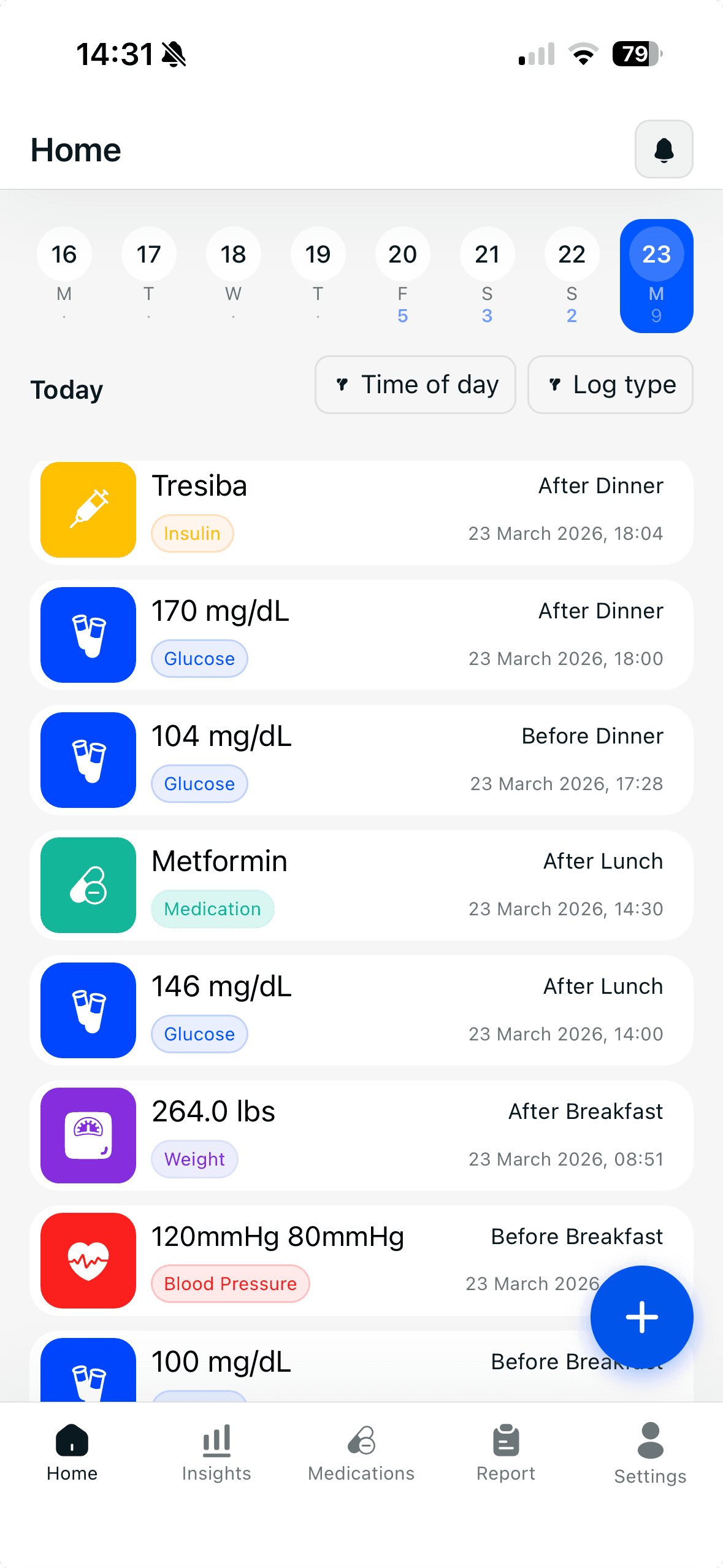
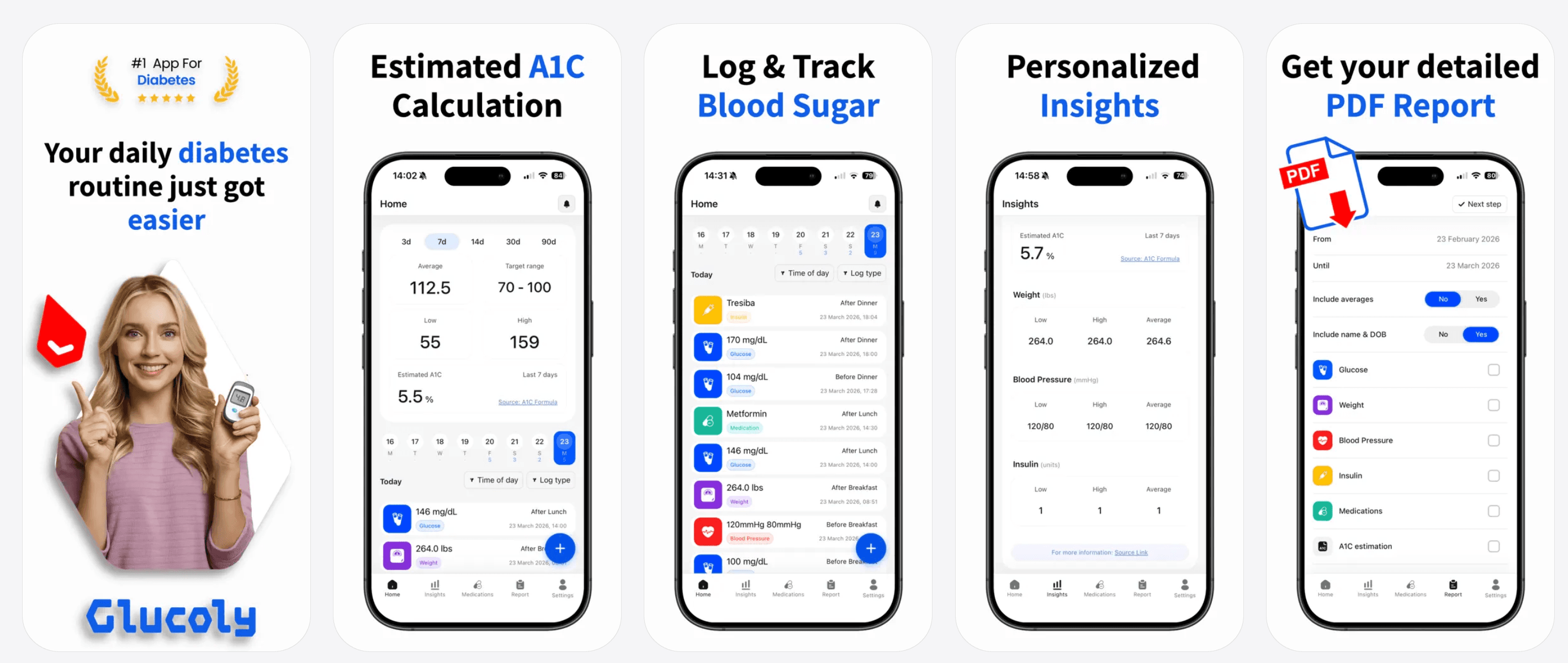
Knowing which insulin you take is only half the picture. The other half is understanding how your doses interact with your glucose readings - and that requires logging both, side by side, over time. When you log your basal dose, your bolus doses, and your glucose readings in Glucoly, patterns that are invisible in the moment become clear across a 7-day or 14-day trend view.
For example: if your fasting glucose is consistently above 130 mg/dL (7.2 mmol/L), your basal dose may need adjustment. If your glucose spikes two hours after every meal, your insulin-to-carb ratio may be off. If you're going low in the mid-afternoon, your lunchtime bolus may be too large - or your basal may be peaking at the wrong time. These are conversations your care team needs real data to have.
- Log every insulin dose (type, units, and time) alongside your glucose readings in Glucoly.
- Use Glucoly's smart reminders to make sure you never miss a basal injection or a pre-meal bolus.
- View 7-day and 14-day glucose trends alongside your dose history to spot the relationship between doses and outcomes.
- Export a doctor-ready PDF from Glucoly before your next endocrinology appointment - your care team can see your full dose log and glucose curve at a glance.
- Glucoly tracks both basal and bolus insulin separately, so you can see the complete picture of your regimen.
This article is for general education and is not medical advice. Consult your healthcare provider before making changes to your insulin regimen or treatment plan. Insulin adjustments should always be made in collaboration with a qualified clinician.
Frequently Asked Questions
What is the difference between basal and bolus insulin?
- Basal insulin is a long-acting background insulin that keeps blood sugar stable between meals and overnight - it replaces the continuous low-level insulin a healthy pancreas releases all day.
- Bolus insulin is a rapid-acting or short-acting insulin taken at mealtimes to cover the carbohydrates you eat and correct any pre-meal glucose above your target.
- Most people with Type 1 diabetes need both: one basal injection daily plus a bolus injection before each meal.
- Some people with Type 2 diabetes start with basal insulin only and add bolus insulin later if needed - discuss your regimen with your endocrinologist.
Do people with Type 2 diabetes need insulin?
- Not always - many people with Type 2 diabetes manage well with lifestyle changes, oral medications, and injectable non-insulin agents (such as GLP-1 receptor agonists).
- Insulin becomes necessary when other treatments are no longer sufficient to keep A1C and fasting glucose within target range.
- According to the American Diabetes Association, Type 2 diabetes is progressive - the pancreas produces less insulin over time, and insulin therapy is a natural part of long-term management for many people, not a failure.
- Starting insulin earlier rather than later has been shown to reduce complication risk by keeping glucose better controlled.
How should I store insulin?
- Unopened insulin: store in the refrigerator (36–46°F / 2–8°C). Never freeze insulin - freezing destroys it.
- In-use insulin: most vials and pens can be kept at room temperature (below 77–86°F / 25–30°C) for 28–56 days, depending on the brand - check the package insert for your specific insulin.
- Keep insulin away from direct sunlight and heat. Never leave it in a hot car or in direct sun.
- Inspect each dose before injecting: rapid-acting analogs should be clear and colorless; NPH and premixed insulins should be uniformly cloudy after rolling. Discard any vial that looks discolored, cloudy when it shouldn't be, or has particles.
- When traveling, carry insulin in a temperature-insulating case - not in checked luggage, where cargo holds can freeze.
Sources
- American Diabetes Association. Standards of Medical Care in Diabetes 2024. diabetes.org
- Centers for Disease Control and Prevention. Insulin Therapy. cdc.gov/diabetes/treatment
Log your basal and bolus doses alongside your glucose readings in Glucoly - and bring a doctor-ready PDF report to your next appointment. Free on the App Store and Google Play.
Download GlucolyShare this article
Related Posts
What Is LADA (Type 1.5 Diabetes)? Symptoms and How It Differs from Type 1 and Type 2
LADA (type 1.5 diabetes) is autoimmune diabetes that develops slowly in adults, often misdiagnosed as type 2.…
Read more →EducationDiabetic Retinopathy: How Diabetes Affects Your Eyes (and How to Protect Them)
Diabetic retinopathy is the leading cause of blindness in adults — largely preventable. Learn the stages, symp…
Read more →EducationWhat Is Diabetic Ketoacidosis (DKA)? Warning Signs You Must Know
DKA is a life-threatening diabetes emergency. Know the warning signs — fruity breath, vomiting, confusion — an…
Read more →